
“The Lymphoid Lineage: Special Forces of Your Immune System”

In our last article, we learnt about the second group of myeloid cells i.e. monocytes, macrophages, and dendritic cells.

We learnt about the following things-
Monocytes are leukocytes(white blood cells) that circulate in the blood lets say they are mobile recruits. Macrophages are the long-lived commanders. They are the mature form of monocytes. Once monocytes leave the bloodstream and enter your body’s tissues, they mature into macrophages and take up permanent residence.
Macrophages secrete the cytokines that recruit neutrophils and other leukocytes into the infected area.
Dendritic cells share some traits with macrophages but serve as the messengers of the immune system.
Mast cells, found in connective tissues, are powerful allies against infection. Packed with granules, they release inflammatory mediators upon activation, fueling the body’s rapid response to threats.
Today we will talk about The Lymphoid Lineage which are Special Forces and Elite Fighters, but before that lets revise little bit about what we had learn about lineages till now. I’ve prepared flowchart that will help you easily to know about lineages. (Following flow chart was prepared via Canva, and information taken from the references mentioned at end of article below, Thanks)
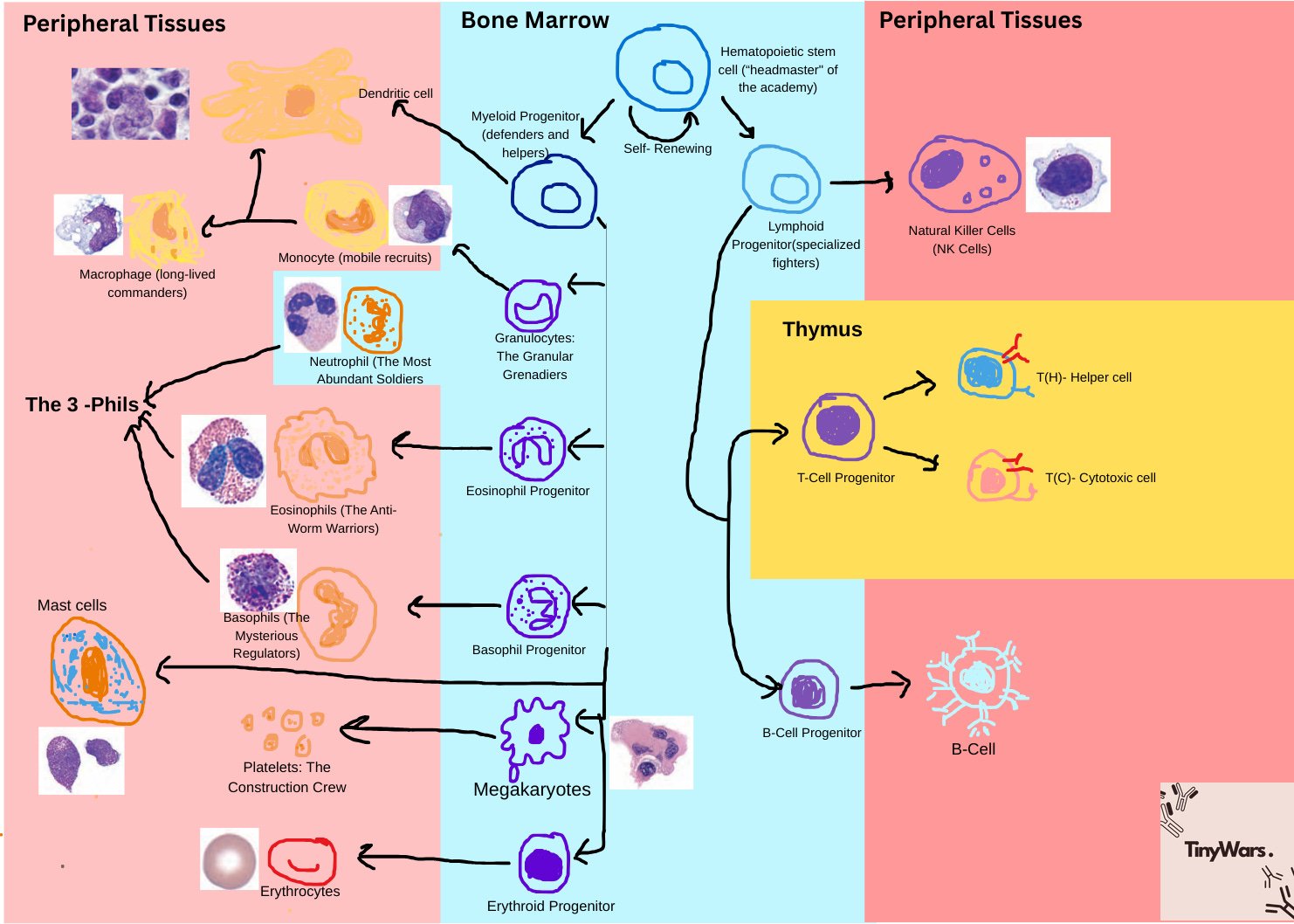
The middle part i.e. in sky blue in colour, Those cells are derived from or present in Bone marrow, for example neutrophile. Other two side which are in red colour sheds are from peripheral tissues. The in orangish yellow, those cells are derived from thymus. And for little too much familiarity purpose, I’ve added different analogy that introduced in previous few posts about lineages.
I would be glad if you guys summaries or few lines about whatever you learn from the flow chart in the comment section. You can read previous articles also, maybe interesting thing you can do us in one part, you can read about article with the help or exploring flow chart side by side. Hope it helps, let me know in the comment section thanks.
We’ve explored the frontline defenders of the myeloid lineage. Now, get ready to meet the special forces: the Lymphoid Lineage! This branch holds the keys to both quick, deadly defense and the highly specialized strategy of the adaptive immune system!
The Lymphoid Lineage: Special Forces and Elite Fighters
The lymphoid progenitor cells give rise to the lymphoid lineage of white blood cells. When we look at the lymphocytes (the main cells of this lineage) under a microscope, they fall into two groups:
1. Large Lymphocytes: Natural Killer (NK) Cells
These are the large granular lymphocytes, powerful effector cells of innate immunity. They are known as Natural Killer cells or NK cells and are your body’s specialized defense against viral infections.
Role: Think of them as the “Viral SWAT Team.” They enter infected tissues and:
Kill: They stop the spread of infection by directly killing the body’s own cells that have been taken over by a virus.
Impeding Replication: They secrete cytokines (signaling proteins) that slow down the virus’s ability to make copies of itself within other infected cells.
2. Small Lymphocytes: The Adaptive Masters
These are the small lymphocytes, and they are the heroes responsible for the entire adaptive immune response. They are small because they usually circulate in a quiet, immature form, like superheroes in civilian clothes that are functionally inactive.
Activation: Everything changes when one of these small lymphocytes recognizes a pathogen. This triggers a rapid process of selection, growth, and specialization.
The Response: After about 1–2 weeks, this process produces an incredibly powerful, focused response that is perfectly tailored to the invading organism. This is how your body develops the specific, long-lasting immunity we talked about earlier!
With the lymphoid lineage, your immune system gains its special forces, rapid response NK cells and the highly trained B and T cells that build long-term immunity. Together, they ensure your body doesn’t just fight infections but also remembers past battles, staying prepared for future threats.
References:
Parham, P., & Parham, P. (2014). The Immune System (4th ed.). W.W. Norton & Company. https://doi.org/10.1201/9781317511571
Kuby Immunology Judy A. Owen, Jenni Punt, Sharon Stranford
Basic Immunology (Fifth edition), by Abul K. Abbas, Andrew H. Lichtman and Shiv Pillai.
As always, You can read previous Immunology quests here:- Thanks!!!!


This series is really really helpful. Loved this so much and honestly I just quickly skimmed through the other posts of this series to revise what I had already learnt.
So here's how I am summarizing it. Do correct me if I am wrong, please.
According to the flowchart and my understanding,
1. Hematopoiesis happens to produce new cells. This refers to the process of formation of new cells in our bone marrow.
2. All the cells originate from Hematopoietic stem cell.
3. Cells branch into three lineages--Erythroid Lineage, Myeloid lineage, Lymphoid Lineage.
4. Myeloid Lineage Cell branches into several different type of cells like- Granulocytes, Monocyte etc.
5. Granulocyte give rise to Neutrophil, Basophil and Eosinophil. It also gives rise to Dendritic Cell and Monocyte--which in turn convert into Macrophage. It also give rise to Mast cells.
(I didn't get it tho how Erythrocytes are originated from Granulocytes because aren't they from Erythroid lineage?)
6. Neutrophils are like soldiers who at the spot of infection attack on it in large numbers. Eosinophils help in worms infection and Basophils are rare but help in parasite infection.
7. Monocyte are similar to Granulocyte but are bigger than monocytes (their function is similar to Neutrophils only, right?) but when they reach the tissues they become macrophage and are general scavenger there.
8. Dendritic cells act as a signal carrier which inform the immune system about the incoming pathogen.
9. Mast cells are present in connective tissues.
10. Then we look at Lymphoid Lineage.
11. There are two types of them. One is Natural Killer Cell that helps us in viral infection and other one is the one that produces antibodies and helps in adaptive immunity. (B and T cells)
Sorry for such a long comment. But it did help me revise. I wish there was something like this for physics too. And chem too. I such at science I have started to feel but I love it too at the same time.
Thank you so much for making these explanations so much fun and easier. The flowchart also was so helpful.
A great read!!
You simplify things in a concise way Saurabh. All the nomenclature is a little tedious. Let me ask you a question - a friend of mine with a high count of lymphocytes was diagnosed impending cancer, kind of wait and watch type. She seems ok so far - was the diagnosis wrong?