
“Neutralize, Tag, Destroy: How Antibodies Win Our Invisible Wars”
-A Deep Dive Into Antibody Superpowers

Fist of all, I’m apologising for not posting in previous 2 weeks, just caught up with some adventures and will try to stay consistent (hehe, yes I’ll).
In previous article, we pulled back the curtain on the elite agents of adaptive immunity the B and T cells. Both arise from the same training academy but specialize in unique combat styles. B cells forge antibodies, the precision-guided missiles of our immune arsenal, while T cells act as assassins, strategists, and peacekeepers. Discover how their teamwork defines immunity’s memory and precision and why no two immune battles are ever the same. In case you missed it you can explore it here:

In this article, we will explore how antibodies secreted by plasma cells serve as the core weapons of humoral immunity.
Antibodies: The Soluble Missiles of Humoral Immunity
The weapons secreted by plasma cells are called antibodies. Once released, these antibodies circulate in the blood and can enter infected tissues.
The immunity provided by the action of these antibodies is known as humoral immunity. This name comes from the old word for body fluids, “humors,” because antibodies were first discovered floating around in body fluids like blood and lymph.
Let’s break down the two major ways these soluble missiles neutralize pathogens and help the immune system win its battles.
Attack Mode 1: Neutralization (The Disarming Trick)
One way antibodies defeat villains is through neutralization.
How it Works: The antibody binds tightly to a critical spot on the pathogen (like a virus or a bacterial toxin). This tight binding covers up that critical site, stopping the villain from doing its job.
The Superhero Analogy: Think of this as putting a “power-dampening cuff” on the villain.
For example, an antibody binding to the influenza virus prevents the virus from entering and infecting human cells.
Similarly, an antibody can bind tightly to a bacterial toxin, covering its active site and abrogating (canceling out) its lethal effect on human cells.
Attack Mode 2: Opsonization (The Target Marker)
The most important function of antibodies is to make it easy for the massive, engulfing heroes the phagocytes (like neutrophils and macrophages) to destroy extracellular villains.
The Coating: Pathogens have a high density of similar molecules on their surface. An antibody specific for one of these molecules will coat the entire surface of the pathogen like a paint job.
The Phagocyte’s Receptor: Our phagocytic heroes have special cell-surface receptors designed to bind to the tail end of the antibody (the part not attached to the antigen).
The Outcome: Thousands of these phagocyte receptors bind to the thousands of antibodies coating the pathogen. The pathogen is covered in signals, making it impossible to escape. It is rapidly engulfed and destroyed.
The Phenomenon: This process, where a coating of antibody facilitates the destruction by phagocytes, is called opsonization. A bacterium coated with antibody is far more efficiently eaten than a naked one!
In essence, antibodies are excellent at both disarming villains directly (neutralization) and tagging them for rapid capture and elimination (opsonization).
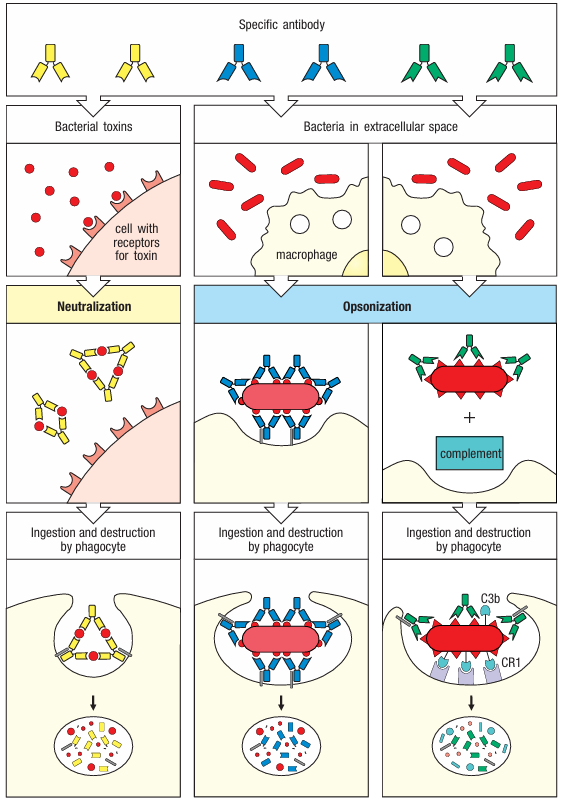
Figure: Mechanisms by which antibodies combat infection. Left panels: antibodies bind to a bacterial toxin and neutralize its toxic activity by preventing the toxin from interacting with its receptor on human cells. The complex of toxin and antibodies binds to macrophage receptors through the antibody’s constant region. Finally, the macrophage ingests and degrades the complex. Right panels: the opsonization of a bacterium by coating it with antibody. When the bacterium is coated with IgG molecules, their constant regions point outward and can bind to receptors on a macrophage, which then ingests and degrades the bacterium. (Image taken from The Immune System [Fourth Edition] by Peter Parham).
In essence, antibodies are excellent at both disarming villains directly (neutralization) and tagging them for rapid capture and elimination (opsonization).
Let me know if you’ve any doubts……….
References:
Parham, P., & Parham, P. (2014). The Immune System (4th ed.). W.W. Norton & Company. https://doi.org/10.1201/9781317511571
Kuby Immunology Judy A. Owen, Jenni Punt, Sharon Stranford
Basic Immunology (Fifth edition), by Abul K. Abbas, Andrew H. Lichtman and Shiv Pillai.
As always, You can read previous Immunology quests here:- Thanks!!!


This was a great one again, really. Very helpful and interesting. Especially how antibodies make cell-toxin complex.