
The Sneeze Reflex Part I
-It’s not just a "tickle"-it’s a high-speed bio-ejection system!

A quick note before we begin, thank you for your patience. I’ve been a little quiet here over the past couple of months while I was in middle of work and some personal time. Currently I’m rethinking how I want to tell science stories on this platform. I’m excited to be back, and I hope this deep dive into the sneeze circuit makes the wait worthwhile.
The Neural Blueprint: The Sneeze Circuit
A sneeze can propel air at nearly 100 km/h, eject tens of thousands of particles, and briefly turn you into a walking aerosol generator. But this explosive reflex doesn’t start in your nose, it begins deep in your nervous system, running on a tightly wired neuro-immune circuit designed to protect your lungs at all costs.
Sneezing isn’t a local irritation. It’s a high-speed reflex arc connecting your face to your brainstem, coordinating sensory neurons, immune signals, respiratory muscles, and airflow in milliseconds.
The Headquarters: The central command for sneezing is the trigeminal nucleus (specifically in the medial ventral part of the spinal cord and central sensory of nasal sensory neurons).
The Key Player (NMB): As you noted, Neuromedin B (NMB) is the essential “messenger” here. Recent studies (2021 Li et al.) show that if you take away NMB or its receptors, the body essentially “unplugs” the sneeze button.
The Immune Cross-Talk
The sneeze reflex is a perfect example of the neuro-immune interface. It’s not just nerves acting alone:
Cytokines and Neuropeptides: When your immune system detects a villain (like pollen or a virus), immune cells release signaling molecules like cytokines.
The Modulation: These molecules actually lower the “firing threshold” of your sensory neurons. In plain English: your immune system tells your nerves to be extra “jumpy,” making you sneeze more easily to get the invaders out faster.
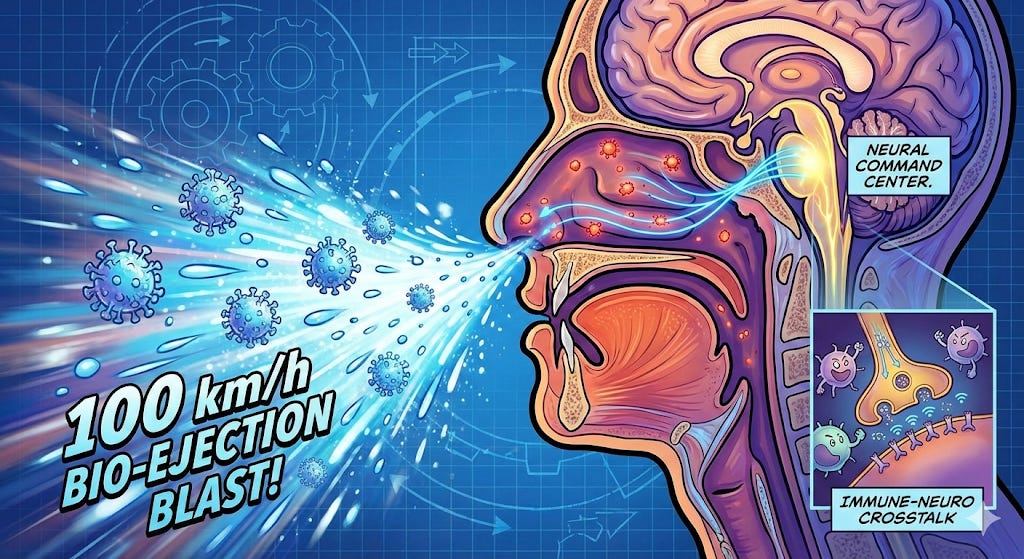
(Created Via Google Gemini)
The Biohazard Blast: Aerosol Transmission
This is where the sneeze goes from a personal reflex to a public health event. The numbers you provided are a stark reminder of why we cover our noses:
Sneeze Statistics
Droplet Count- Up to 40,000 virus-laden droplets.
Travel Distance- 7–8 meters (about the length of a small bus).
Airborne Time- Suspended for up to 10 minutes.
The “Photo-Induced” Mystery: ACHOO Syndrome
The photic sneeze reflex, technically called ACHOO (Autosomal-dominant Compelling Helio-Ophthalmic Outburst) syndrome is one of biology’s strangest “crossed wires.”
The Theory: Most scientists believe it’s a case of optic-trigeminal crosstalk. The optic nerve (which reacts to bright light) and the trigeminal nerve (which triggers the sneeze) are neighbors in the brainstem. When the sun hits your eyes, the signal “leaks” over to the sneeze center.
The “Tickle”: This is why many “photic sneezers” feel a distinct prickling sensation in their nose the moment they look at a bright light.
The Trigger: Sensors on High Alert
The sneeze isn’t just a random twitch; it’s a precision-engineered response. It starts when sensors (receptors) in your nasal cavity and throat detect “intruders” like pollen, smoke, or dust.
The Messengers: These receptors send out an SOS via specialized C-type neurons and cholinergic neurons.
The Command Center: While it feels like a simple “tickle,” the signal actually travels to the Central Nervous System, where your brain integrates the data and decides to pull the trigger on a full-body reflex.
The Blast: 100 km/h Airflow
When your brain gives the “GO” signal, your body generates a massive burst of pressure. Recent research shows that the airflow during a sneeze can reach speeds of nearly 100 kilometers per hour!
The “Why”: This high-velocity blast is designed to physically expel foreign particles and irritants out of the building.
Gatekeeping: By launching these particles out of the nose, the sneeze prevents them from traveling deeper into the lower respiratory tract, where they could cause much more serious trouble.
The Inflammation Hair-Trigger
Sometimes, you aren’t just sneezing because of a piece of dust. In the case of infections, the body is already in “battle mode.”
Inflammatory Reactions: During an illness, the body’s internal inflammatory response directly stimulates those nasal receptors.
Overall Defense: This means the sneeze reflex is actually part of your overall immune response. Your body uses inflammation to “prime” the sneeze reflex, making it more sensitive so it can aggressively clear out the viruses and bacteria causing the infection.
The Big Picture: Sneezing is your body’s way of saying, “You don’t have to go home, but you can’t stay here!” It’s a beautifully coordinated effort between your nervous system and your immune system to keep your airways clear and your lungs safe.
Let me know if you’ve any doubts……….
References:
Li F., Jiang H., Shen X., Yang W., Guo C., Wang Z., et al. (2021). Sneezing reflex is mediated by a peptidergic pathway from nose to brainstem. Cell 184 3762–3773.e10. 10.1016/j.cell.2021.05.01
Nonaka S., Unno T., Ohta Y., Mori S. (1990). Sneeze-evoking region within the brainstem. Brain Res. 511 265–270. 10.1016/0006-8993(90)90171-7
Seijo-Martínez M., Varela-Freijanes A., Grandes J., Vázquez F. (2006). Sneeze related area in the medulla: Localisation of the human sneezing centre? J. Neurol. Neurosurg. Psychiatry 77 559–561. 10.1136/jnnp.2005.06860
Kabata H., Artis D. (2019). Neuro-immune crosstalk and allergic inflammation. J. Clin. Invest. 129 1475–1482. 10.1172/JCI124609
Voisin T., Bouvier A., Chiu I. M. (2017). Neuro-immune interactions in allergic diseases: Novel targets for therapeutics. Int. Immunol. 29 247–261. 10.1093/intimm/dxx040
Bourouiba L. (2020). Turbulent gas clouds and respiratory pathogen emissions: Potential implications for reducing transmission of COVID-19. JAMA 323 1837–1838. 10.1001/jama.2020.4756
Bourouiba L. (2016). Images in clinical medicine. a sneeze. N. Engl. J. Med. 375:e15. 10.1056/NEJMicm1501197
Scharfman B. E., Techet A. H., Bush J. W. M., Bourouiba L. (2016). Visualization of sneeze ejecta: Steps of fluid fragmentation leading to respiratory droplets. Exp. Fluids 57:24. 10.1007/s00348-015-2078-4
Shetty P. A., Bhat S., Jain V., Girish S., Shetty H., Kudlu K. P. (2023). Implication of photic sneeze reflex in ophthalmology. Ind. J. Ophthalmol. 71:2629. 10.4103/IJO.IJO_107_23
Sevillano C., Parafita-Fernández A., Rodriguez-Lopez V., Sampil M., Moraña N., Viso E., et al. (2016). A curious fact: Photic sneeze reflex. autosomical dominant compelling helio-ophthalmic outburst syndrome. Arch. Soc. Esp. Oftalmol. 91 305–309. 10.1016/j.oftal.2016.01.011
Baraniuk J. N., Kim D. (2007). Nasonasal reflexes, the nasal cycle, and sneeze. Curr. Allergy Asthma Rep. 7 105–111. 10.1007/s11882-007-0007-1
Han M., Ooka R., Kikumoto H., Oh W., Bu Y., Hu S. (2021). Experimental measurements of airflow features and velocity distribution exhaled from sneeze and speech using particle image velocimetry. Build Environ. 205:108293. 10.1016/j.buildenv.2021.10829
Burke W. (2012). Why do we sneeze? Med. Hypotheses 78 502–504. 10.1016/j.mehy.2012.01.017
Hi, surprised at those numbers - distance traveled and speed, never thought a sneeze can be that strong. ACHOO full form is a new lesson too. Thanks Sourabh, well written
So well written